Textbook chapter 12
Model a solid as familiar pieces. Add or subtract volumes, but count only exposed surfaces when calculating an exterior area.
Textbook exercise solutions
- Exercise 12.1 — 9 question groups
- Exercise 12.2 — 8 question groups
Videos, notes and tests
English · Session 2026–27 · NCERT-aligned study guide
Chapter overview
Model a solid as familiar pieces. Add or subtract volumes, but count only exposed surfaces when calculating an exterior area.
Before you begin: Areas of circles, solid shapes, unit conversions and Pythagoras.
Key concepts · Solved examples · Practice · Mind map · Timed chapter test
Learn the key concepts
Identify the component solids
Sketch the object as a combination of two solids. Mark common radii, heights and contact faces. The volume of a joined object is the sum of non-overlapping component volumes; a cavity is subtracted.
Exposed surface area
A face where solids touch is internal and is not painted or wrapped. A hemisphere on a cylinder hides the cylinder’s top disk and the hemisphere’s base disk. Whether the bottom is included depends on the question.
Choose the right height
A cone uses vertical h for volume and slant height l for curved area; l²=r²+h². Convert every length to the same unit before calculations. A length scale factor k changes area by k² and volume by k³.
Formula and result checklist
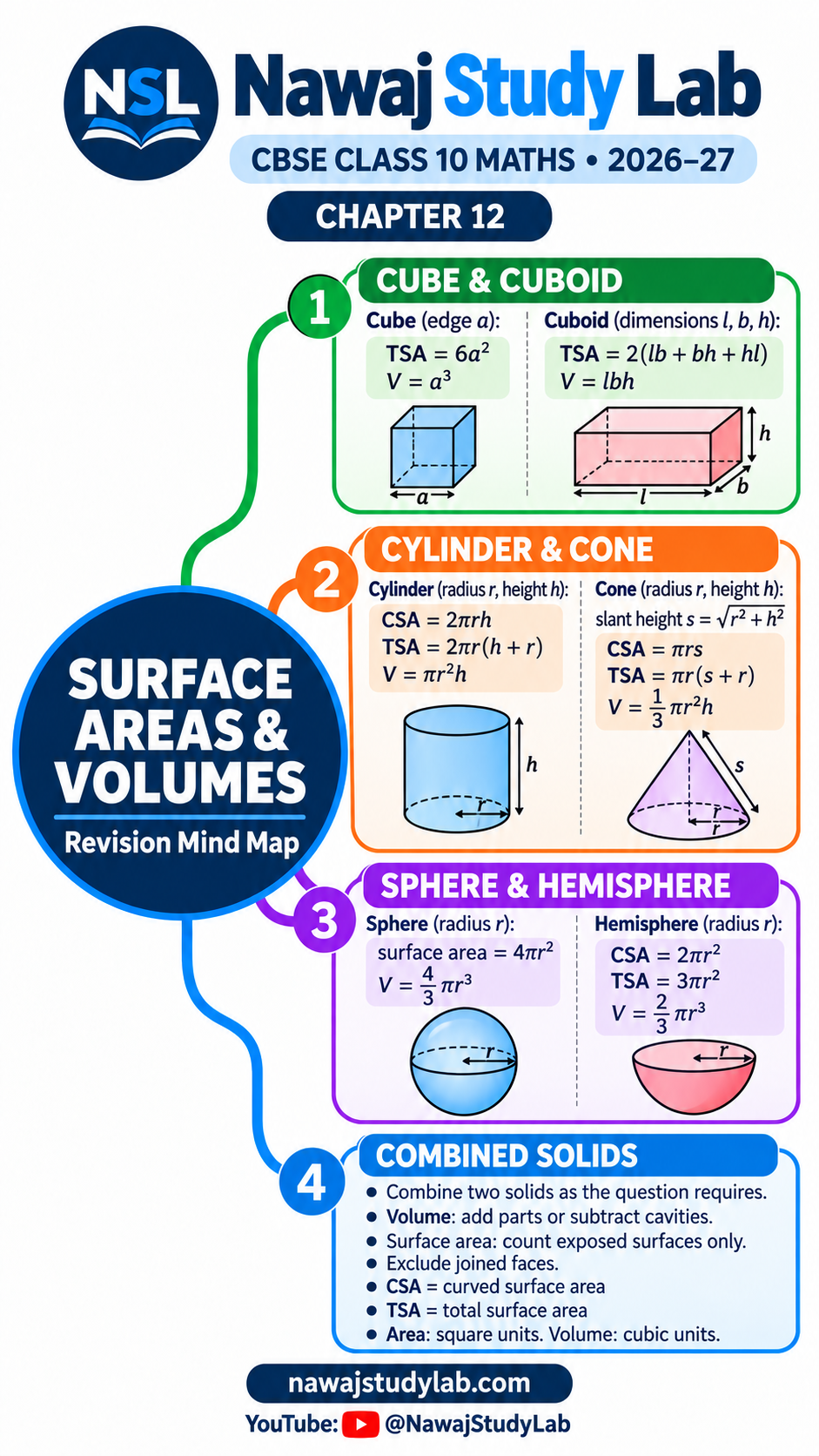
- Cuboid: V=lbh; TSA=2(lb+bh+hl). Cube: V=a³; TSA=6a².
- Cylinder: V=πr²h; CSA=2πrh; TSA=2πr(h+r).
- Cone: V=πr²h/3; CSA=πrl; l=√(r²+h²).
- Sphere: V=4πr³/3; SA=4πr². Hemisphere: V=2πr³/3; CSA=2πr²; TSA=3πr².
Solved examples
Example 1
Find the volume of a cylinder of radius 3 cm and height 10 cm topped by a hemisphere of the same radius.
Cylinder volume=90π; hemisphere volume=(2/3)π×27=18π. Total=108π cm³.
Example 2
For the same solid, find exterior area including the bottom.
Exposed area=cylinder CSA+hemisphere CSA+bottom disk =60π+18π+9π=87π cm². The joined circular face is excluded.
Example 3
Find the slant height and curved area of a cone with r=5 cm,h=12 cm.
l=√(25+144)=13 cm. CSA=π×5×13=65π cm². Volume, if needed, is (1/3)π×25×12=100π cm³.
Try it yourself
Work on paper before opening each answer. Show the reasoning and include units when needed.
1. Find volume of a sphere of radius 3 cm.
Check answer 1
36π cm³.
2. Find total area of a hemisphere of radius 4 cm.
Check answer 2
48π cm², including the base.
3. A cube has side 5 cm. Find volume and total area.
Check answer 3
125 cm³ and 150 cm².
Common mistakes to avoid
- Do not add concealed contact faces to exterior area.
- Use vertical height for cone volume and slant height for cone curved area.
Chapter mind map
View this chapter in the Mind Maps library · Open full-size image
Check your understanding
Take the 6-question, 10-minute chapter practice test. Each correct answer earns 1 mark; there is no negative marking. See explanations after submission.
Start chapter 12 practice test →
Continue learning
Read the corresponding chapter in the official NCERT textbook, then complete its exercises on paper. These NSL explanations and original practice questions support your textbook study; they are not an exercise-by-exercise solution manual.
Official CBSE syllabus 2026–27 · All chapters · Previous chapter · Next chapter
Check what you have learned
Finished the topics? Practise with the free chapter test.
Start free test