Textbook chapter 14
Measure the chance of an event in a finite equally likely sample space and check answers using complementary events.
Textbook exercise solutions
- Exercise 14.1 — 25 question groups
Videos, notes and tests
English · Session 2026–27 · NCERT-aligned study guide
Chapter overview
Measure the chance of an event in a finite equally likely sample space and check answers using complementary events.
Before you begin: Fractions, percentages, sets of outcomes and simple counting.
Key concepts · Solved examples · Practice · Mind map · Timed chapter test
Learn the key concepts
Equally likely outcomes
The classical probability model divides favourable outcomes by all equally likely outcomes. State the sample space before counting. A fair die has six equally likely faces; an unfair die does not support the same simple count.
Complementary events
The event not E contains every outcome outside E. Its probability is 1−P(E). Impossible events have probability 0 and certain events 1. A probability cannot be negative or exceed 1.
Counting carefully
When tossing two fair coins, distinguish HT from TH; the four ordered outcomes are HH,HT,TH,TT. For a bag, count physical objects, not merely colour names. Unless replacement is specified, removing an object changes later counts. The questions here concern single draws or clearly stated simple experiments.
Formula and result checklist
- P(E)=number of favourable outcomes / number of equally likely outcomes.
- 0≤P(E)≤1; P(not E)=1−P(E).
Solved examples
Example 1
A fair die is rolled. Find probability of a prime number.
The sample space is {1,2,3,4,5,6}. Prime faces are {2,3,5}; 1 is not prime. Probability=3/6=1/2.
Example 2
A bag has 5 red and 7 blue balls. One is drawn at random. Find P(not red).
There are 12 balls and 7 are not red, so probability=7/12. Check using 1−5/12=7/12.
Example 3
Two fair coins are tossed. Find probability of exactly one head.
Four equally likely ordered outcomes: HH,HT,TH,TT. Favourable outcomes HT,TH give 2/4=1/2. Exactly one excludes HH.
Try it yourself
Work on paper before opening each answer. Show the reasoning and include units when needed.
1. A fair die is rolled. Find P(number greater than 4).
Check answer 1
2/6=1/3.
2. If P(E)=0.35, find P(not E).
Check answer 2
0.65.
3. Choose one integer uniformly from 1 to 10 inclusive. Find P(a multiple of 3).
Check answer 3
Numbers 3,6,9 give 3/10.
Common mistakes to avoid
- Do not treat colours as equally likely when their ball counts differ.
- Exactly one, at least one and no heads describe different events.
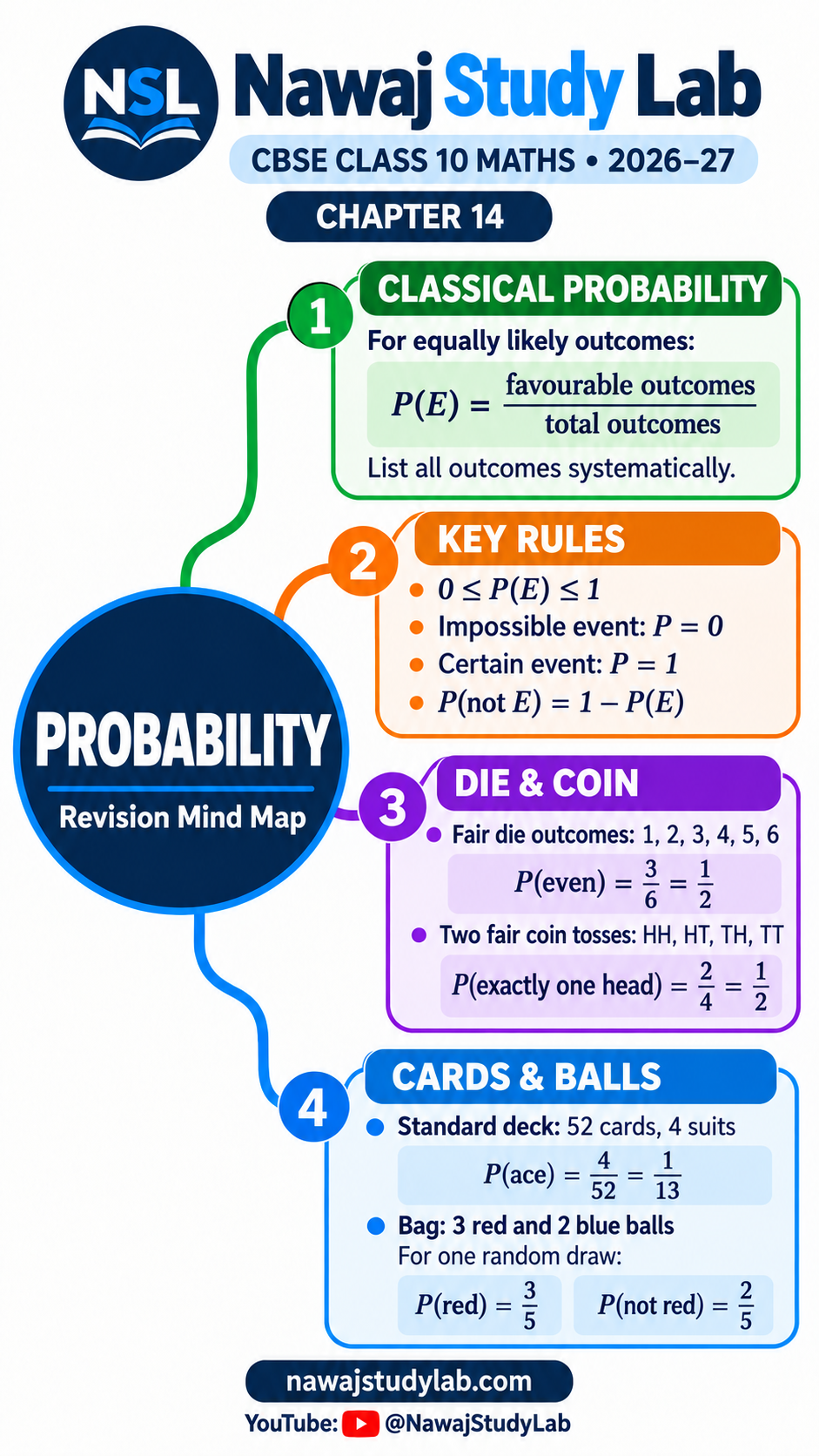
Chapter mind map
View this chapter in the Mind Maps library · Open full-size image
Check your understanding
Take the 6-question, 10-minute chapter practice test. Each correct answer earns 1 mark; there is no negative marking. See explanations after submission.
Start chapter 14 practice test →
Continue learning
Read the corresponding chapter in the official NCERT textbook, then complete its exercises on paper. These NSL explanations and original practice questions support your textbook study; they are not an exercise-by-exercise solution manual.
Official CBSE syllabus 2026–27 · All chapters · Previous chapter
Check what you have learned
Finished the topics? Practise with the free chapter test.
Start free test