Textbook chapter 4
Solve equations whose highest power of the unknown is two, interpret their roots and use a discriminant to decide which real solutions are possible.
Textbook exercise solutions
- Exercise 4.1 — 2 question groups
- Exercise 4.2 — 6 question groups
- Exercise 4.3 — 5 question groups
Videos, notes and tests
English · Session 2026–27 · NCERT-aligned study guide
Chapter overview
Solve equations whose highest power of the unknown is two, interpret their roots and use a discriminant to decide which real solutions are possible.
Before you begin: Factorisation, square roots and linear equations.
Key concepts · Solved examples · Practice · Mind map · Timed chapter test
Learn the key concepts
Standard form
Expand and collect terms on one side before reading a,b,c from ax²+bx+c=0. The coefficient a must be nonzero. A product equation may become quadratic only after expansion.
Two solving methods
Factorisation uses the zero-product property: if uv=0, at least one factor is zero. The quadratic formula works even when integer factorisation is inconvenient. Use parentheses around −b and the whole denominator 2a.
Discriminant and modelling
D=b²−4ac determines real-root behaviour: D>0 gives two distinct real roots, D=0 one repeated real root, and D<0 no real roots. In a length, time or population problem, discard roots that violate the original context.
Formula and result checklist
- x = [−b ± √(b²−4ac)]/(2a).
- D = b²−4ac.
Solved examples
Example 1
Solve x²−9x+20=0.
Factorise: (x−4)(x−5)=0, so x=4 or x=5. Substitution confirms both roots.
Example 2
Solve 2x²+3x−2=0 using the formula.
a=2,b=3,c=−2. D=9+16=25. x=(−3±5)/4, giving 1/2 and −2.
Example 3
A rectangle is 3 m longer than it is wide and has area 54 m². Find its dimensions.
Let width be w>0. Then w(w+3)=54, so w²+3w−54=(w+9)(w−6)=0. Reject w=−9. Width=6 m and length=9 m.
Try it yourself
Work on paper before opening each answer. Show the reasoning and include units when needed.
1. Solve x²−6x+8=0.
Check answer 1
x=2,4.
2. Find k if x²−4x+k=0 has repeated real roots.
Check answer 2
D=16−4k=0, so k=4.
3. Does 3x²+2x+5=0 have real roots?
Check answer 3
No. D=4−60=−56<0.
Common mistakes to avoid
- Do not omit the ± sign.
- A repeated root does not mean two different numbers.
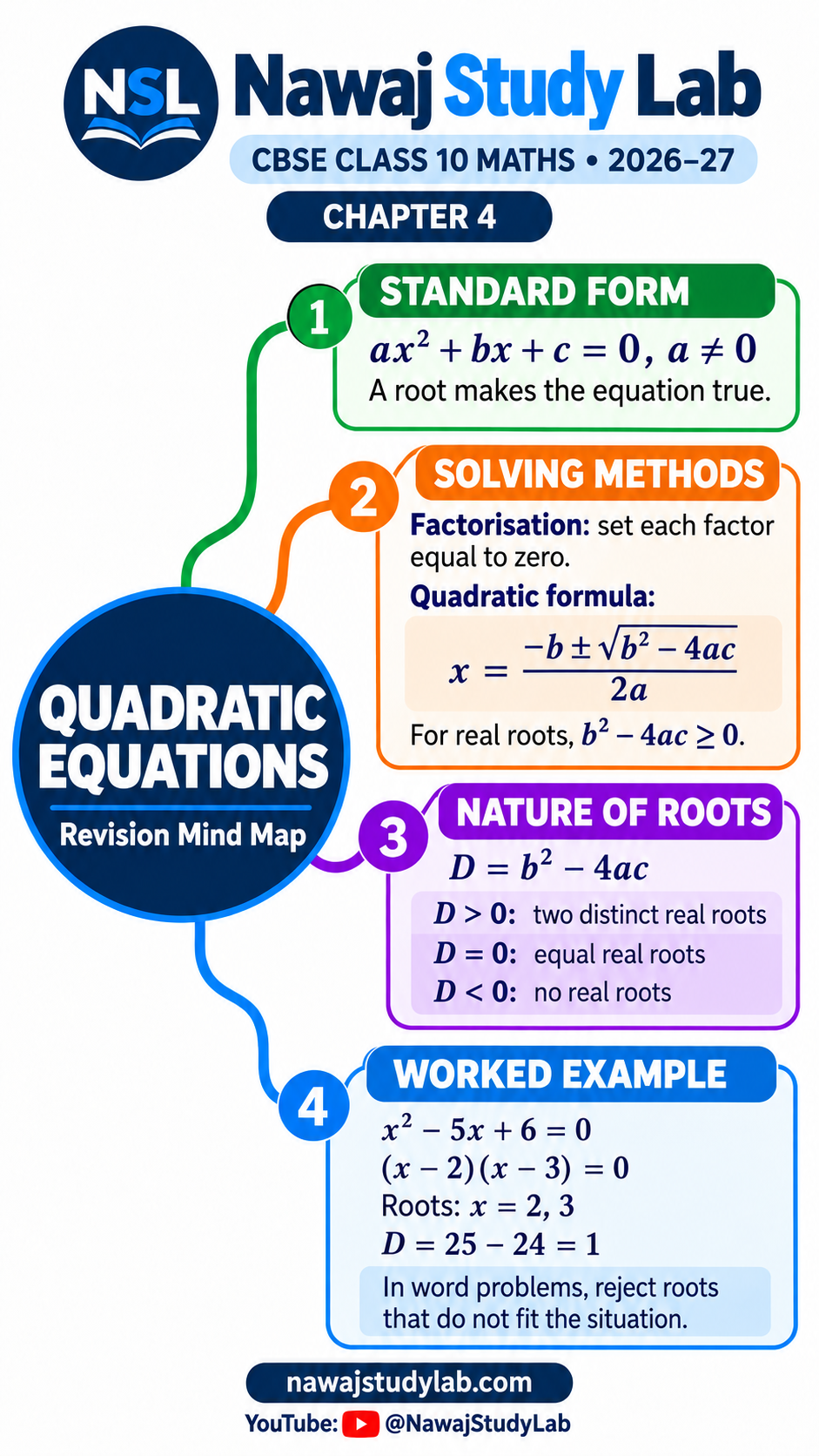
Chapter mind map
View this chapter in the Mind Maps library · Open full-size image
Check your understanding
Take the 6-question, 10-minute chapter practice test. Each correct answer earns 1 mark; there is no negative marking. See explanations after submission.
Start chapter 4 practice test →
Continue learning
Read the corresponding chapter in the official NCERT textbook, then complete its exercises on paper. These NSL explanations and original practice questions support your textbook study; they are not an exercise-by-exercise solution manual.
Official CBSE syllabus 2026–27 · All chapters · Previous chapter · Next chapter
Check what you have learned
Finished the topics? Practise with the free chapter test.
Start free test