Textbook chapter 7
Turn geometric distances and internal ratios into numerical calculations on a coordinate plane. Use results to verify a geometric description.
Textbook exercise solutions
- Exercise 7.1 — 10 question groups
- Exercise 7.2 — 10 question groups
Videos, notes and tests
English · Session 2026–27 · NCERT-aligned study guide
Chapter overview
Turn geometric distances and internal ratios into numerical calculations on a coordinate plane. Use results to verify a geometric description.
Before you begin: Ordered pairs, Cartesian axes, Pythagoras and signed arithmetic.
Key concepts · Solved examples · Practice · Mind map · Timed chapter test
Learn the key concepts
Distance from horizontal and vertical changes
Between A(x₁,y₁) and B(x₂,y₂), the changes are x₂−x₁ and y₂−y₁. They form perpendicular legs of a right triangle, so Pythagoras gives the distance. Squaring makes the order of subtraction irrelevant if used consistently.
Internal division
If P divides AB in ratio AP:PB=m:n, the coordinate of A is weighted by n and that of B by m. A point closer to A has a larger weight on A. Use positive m,n for internal division.
Midpoint and verification
A midpoint divides in ratio 1:1 and is the average of the endpoints in each coordinate. To prove a triangle is isosceles, compare two distances; for a right triangle, test whether the square of the longest side equals the sum of the other two squared lengths.
Formula and result checklist
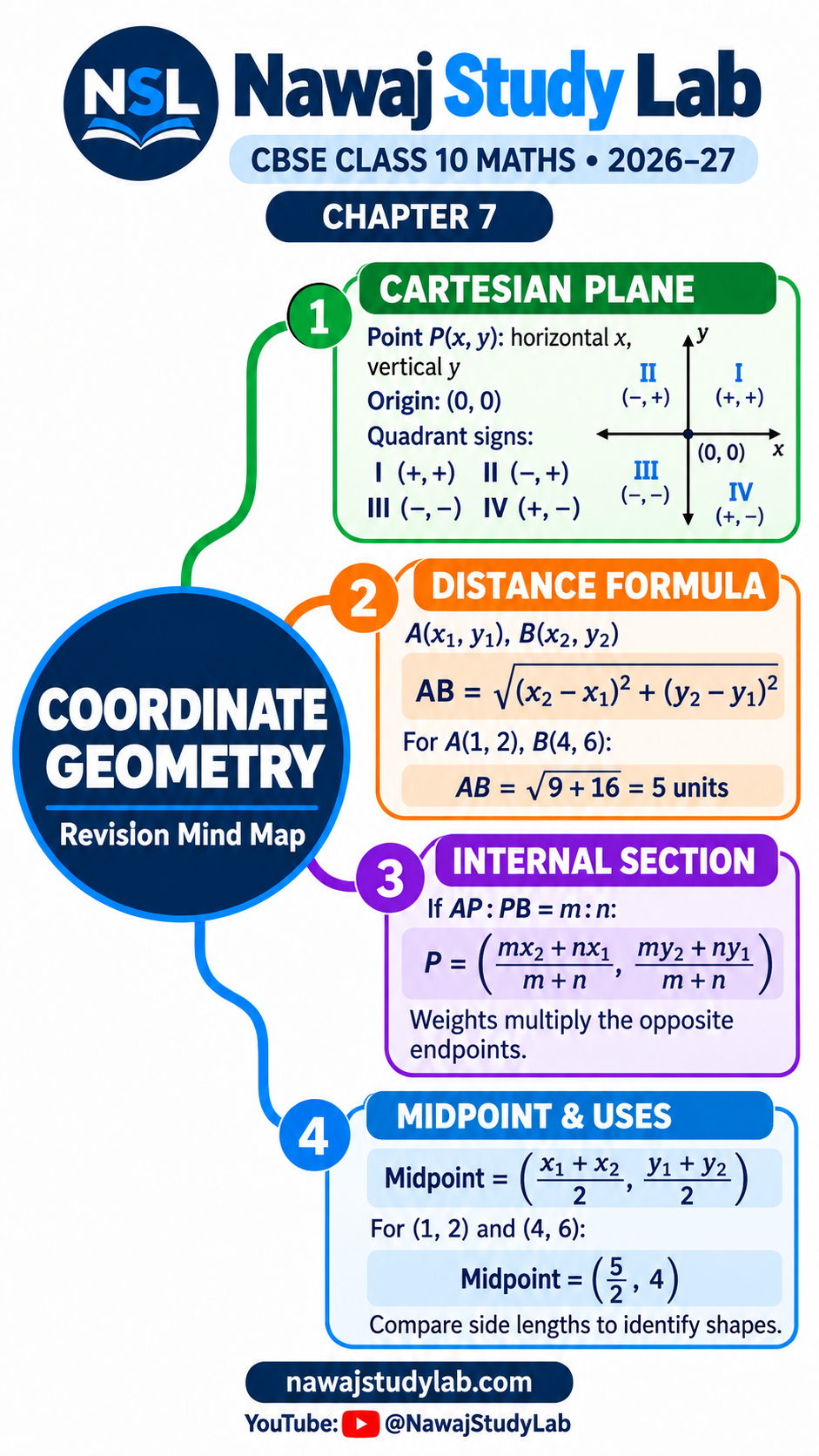
- AB=√[(x₂−x₁)²+(y₂−y₁)²].
- P=((mx₂+nx₁)/(m+n),(my₂+ny₁)/(m+n)).
- Midpoint=((x₁+x₂)/2,(y₁+y₂)/2).
Solved examples
Example 1
Find the distance between (−2,1) and (4,9).
Changes are 6 and 8. Distance=√(36+64)=10 units.
Example 2
Find the point dividing A(1,2), B(7,8) in ratio 1:2 internally.
P=((1×7+2×1)/3,(1×8+2×2)/3)=(3,4). It is one-third of the way from A to B.
Example 3
Show that (0,0),(6,0),(0,8) form a right triangle.
Squared side lengths are 36,64,100. Since 36+64=100, the triangle is right-angled, at (0,0).
Try it yourself
Work on paper before opening each answer. Show the reasoning and include units when needed.
1. Find distance between (2,3) and (2,−4).
Check answer 1
7 units.
2. Find midpoint of (−4,6) and (8,−2).
Check answer 2
(2,2).
3. Divide (0,0) to (9,6) in ratio 2:1 internally.
Check answer 3
(6,4).
Common mistakes to avoid
- Write AP:PB before choosing m,n.
- Distance is nonnegative and uses square roots, not the sum of coordinate differences.
Chapter mind map
View this chapter in the Mind Maps library · Open full-size image
Check your understanding
Take the 6-question, 10-minute chapter practice test. Each correct answer earns 1 mark; there is no negative marking. See explanations after submission.
Start chapter 7 practice test →
Continue learning
Read the corresponding chapter in the official NCERT textbook, then complete its exercises on paper. These NSL explanations and original practice questions support your textbook study; they are not an exercise-by-exercise solution manual.
Official CBSE syllabus 2026–27 · All chapters · Previous chapter · Next chapter
Check what you have learned
Finished the topics? Practise with the free chapter test.
Start free test